

About the Professional Performance Assessment
Measuring the professional performance level from beginner, competent, proficient, to expert
The Professional Performance Assessment is an interactive assessment that covers the entire scope of a professional's work. Performance can also be denoted as expertise and skill level. There is a Professionalism Performance Assessment tailored to the target group for each professional group. Interactivity means that this assessment is more than just a measurement and serves multiple purposes from a socio-constructive perspective. The Formative Assessment for Nurses’ Professional Performance (FAN) comprises 3 job domains, 21 rubrics (i.e., themes), and 93 items with 4 answer categories ranging from beginner to expert levels. The Professional Performance Assessment, for instance, for caregivers, care, facility, and administrative assistants also comprises 3 job domains but fewer items than the FAN, with 3 answer categories ranging from beginner to proficient that match their profession. All answer categories are constructed in a cumulative scale. Every answer is a detailed description of a constituent professional task. We ask for ‘Where are you now?’, the actual expertise level, and ‘Where do you want to go?’, their goal or ambition for professional development.
“Smart measuring makes retraining nurses more effective
The labor market is tight. It is difficult to get skilled personnel. What is more obvious than specifically investigating the need for training of your own employees? [...] More and more hospitals are using an assessment method that maps out whether the skills of nurses match the care level of a department. [...]
Based on a list of 96 questions, the Professionalism Scan measures whether nurses meet the qualifications “beginner”, “competent”, “advanced” or “expert”. In this way, it can be identified at an individual, per team or per department level which skills are available and where there are gaps. A care intensity scan can be used to map out the requirements of a department in relation to the care demand. [...] ‘We are investigating this further. This concerns the most optimal team composition in terms of team performance in relation to patient outcomes,’ says Vasse. ‘You connect with the nurse who wants to know the state of knowledge and practical skills and with their ambition to improve, develop or professionalize. [...]
”
“In Máxima MC we have been using the Frenetti professionalism (self) scan since 2016 and will continue to do so in the coming years. It provides our nurses and their managers with more insight into the competencies they have, use and want to develop in the workplace. In this way, it gives substance to the development conversation between the manager and the nurse. It also provides a good insight into where there is ambition and further development at the team level. Based on this, we work on the development of the nurses in our hospital on an individual and team level.
”

The Professional Performance Assessment is multi-purpose
This workplace-based assessment measures performance and expertise from beginner to expert levels, and the professional's capacity for detailed tasks and behaviors. The assessment has several goals: determining the level of expertise and performance, including the interaction between employees within a team or organization, tracking professional development, determining the capacity present at any time, and ‘who can help whom?’ In addition to measuring and monitoring capacity, this assessment provides information to support the professional or student in learning, developing, and professionalizing. The expertise levels filled in by the professional can be discussed, for example, with colleagues, managers, teachers, or trainers, and can be updated accordingly.
“I realized there were a lot of things we never learned in school. ”
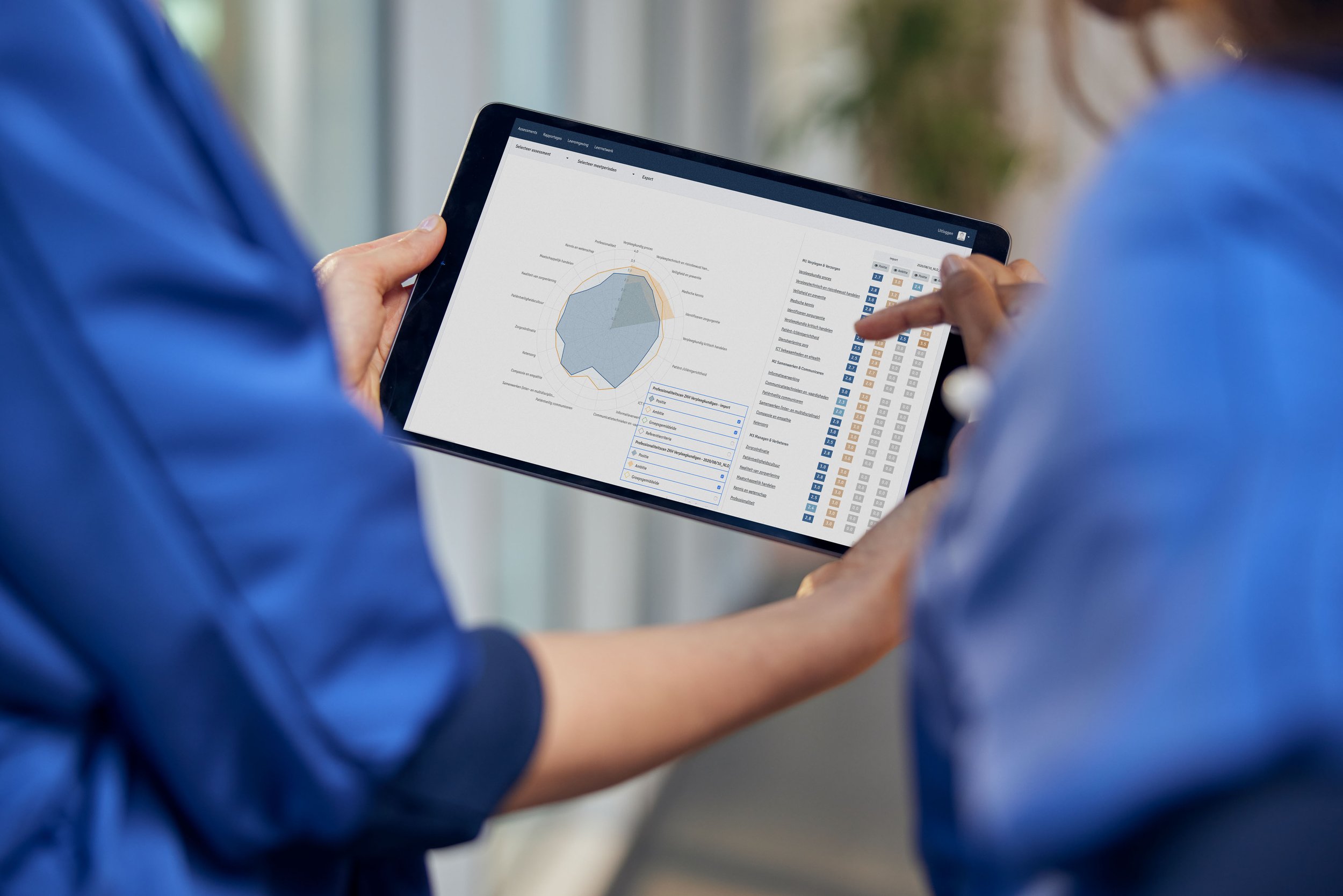
The Professional Performance Assessment gives insight into:
the actual situation concerning the expertise levels and performance of professionals and students;
how different qualities, skills, and expertise are distributed;
what goals professionals and students pursue;
how well is someone prepared to graduate or to continue education;
·how the competencies of training curricula are reflected in skills;
where your organization is vulnerable and runs risks;
where to create and make use of development plans with appropriate learning activities and;
where to set priorities at the individual, team, group, and organizational levels.
“A pretty challenging questionnaire where you had to think carefully about now and the future. It makes you think, not a bad thing. ”

Monitoring and targeted action with actual data
The expertise level and performance are not static, but also depend on the context. For example, a professional who is an expert in department X is not by definition also an expert in department Y. It is important to consider this if a professional starts working in a different context due to necessary upscaling or after an application. The same also applies to a student when changing an internship or workplace. At that moment, it is necessary to update the assessment so that the actual situation is measured at the individual, team, and organizational levels.
Target group: This Formative Professional Performance Assessment is for use amongst others, the following professional /student groups: nurse professionals and students for diverse (specialized) job roles/functions in nursing and care working in hospitals, nursing homes, home care, mental healthcare, rehabilitation centers, and other healthcare facilities or doing internships from school or university. Also for nurse practitioners, caregivers, care assistants, occupational therapists, and facility assistants. A Professionalism Performance Assessment is also available, or can be drawn up for other professions.
“A nice assessment that gives a lot of insights about my functioning and where I want and have to go. ”

Continuously monitoring skills levels
Are we setting the right priorities?
Reflect on whether things are going in the right direction and whether there is a focus to support and help professionals in the current situation. The goal is to reduce the workload. As a bottom-up method, the data within the Frenetti platform can help to make the correct transformations within an organization.
Prioritize and legitimize policies based on current data
Use current data from professionals and make use of data technology. Frenetti helps you to build expertise on how to use the data technology for future policy. The Frenetti platform is about data entered by professionals. The professional indicates where they are now and where they want to go. By learning to read and interpret this data, you can use it for decisions in the field of management of numbers of FTEs, training, acquired competencies, the number of places available for patient care, and other indicators such as the complexity of care.
By continuously having a good overview of your team’s variation in skill levels, using current data, you are better able to act preventively. In addition to the professional, this also benefits the quality of care and patient safety.